

Salary Negotiation Scripts That Work (and Why They Do)

You finally get the job offer. The number looks… fine. Not great, not terrible. You know you should negotiate, but how do you do it without sounding entitled or losing the offer entirely?
This guide walks through real negotiation scripts that consistently increase offers by 5–25%, backed by data, case studies, and behavioral framing. You’ll learn exactly what to say, when not to negotiate, and how to calculate the real financial impact of staying silent.

Quick Comparison: Scenarios, Scripts, and Typical Outcomes
When Not to Negotiate
Negotiation is a skill, but timing is everything. Sometimes the best move is to wait.
Avoid negotiating if:
The company publishes non-negotiable pay bands (common in government, education, or early startups).
You’re already at top of market and have no competing offers.
The offer explicitly states it’s final and equalized across levels (especially in unionized or collective bargaining contexts).
You’re accepting a learning-based role designed as an apprenticeship trade-off.
\(\begin{array}{|l|p{9cm}|} \hline \textbf{Item} & \textbf{Check} \\ \hline \text{Market Research Done} & \text{Reviewed at least two sources (Glassdoor, PayScale, Levels.fyi).} \\ \hline \text{Achievements Quantified} & \text{Have metrics or outcomes that demonstrate impact.} \\ \hline \text{Target Range Defined} & \text{Know your minimum, ideal, and walk-away number.} \\ \hline \text{Timing Chosen} & \text{Planned negotiation before signing or during review cycle.} \\ \hline \text{Script Practiced} & \text{Rehearsed tone, pauses, and phrasing aloud.} \\ \hline \text{Backup Options Ready} & \text{Prepared non-salary asks (PTO, flexibility, signing bonus).} \\ \hline \text{Follow-up Plan} & \text{Have email draft ready to summarize discussion outcomes.} \\ \hline \end{array}\)
Industry and Geography Matter
Negotiation norms differ by sector and region:
Tech and finance: Negotiation expected; offers often start below midpoint.
Nonprofit and public sectors: Structured pay grades; leverage comes from additional duties, not titles.
Europe: Formal discussions, slower cycles; equity less common.
Asia-Pacific: Direct salary discussion may occur late; focus on long-term relationship building.
Source: SHRM Global Pay Practices Report
Case Study 1: Tech PM Negotiations
A mid-level Product Manager, received a base offer of $100,000 from a cloud-software company. After researching on Glassdoor and Levels.fyi, she found the market median for similar roles was $118,000.
Using this adapted script:
“I’m thrilled about this opportunity. Based on market data for similar PM roles and my experience leading cross-functional launches, I was expecting a base in the $120K range. Is there flexibility to adjust closer to that?”
After one conversation, the recruiter returned with $122,000 base + $5,000 signing bonus, a 27% improvement over the initial offer.
Preparation time: 3 hours of research and practice
Outcome: +$27,000 total comp increase
Case Study 2: Healthcare Operations Manager
A hospital operations manager earned $78,000. After taking on scheduling, vendor coordination, and compliance tracking, he requested a review. He presented quantifiable improvements (cut overtime costs by 12%, reduced error rate by 9%) and cited PayScale showing the market midpoint at $86,500.
Script used:
“Since expanding my role into scheduling and compliance, we’ve reduced overtime and improved audit readiness. Based on current benchmarks, I’d like to align my compensation closer to $86,000.”
The hospital raised his salary to $84,500 immediately, plus a commitment to revisit in 6 months.
Preparation: 2 hours of data gathering and manager pre-brief
Outcome: +8.3% raise and stronger review cycle visibility
Realistic Negotiation Outcomes by Level
Source: Salary.com Compensation Trends
The Cost of Not Negotiating
If you accept $90,000 instead of negotiating to $95,000:
Year 1: –$5,000
Over 5 years (3% annual raises): –$26,400
Over 10 years: –$57,800
That’s the equivalent of $2,890 per minute for a 20-minute negotiation.
Research and Preparation Tools
Delivery Matters as Much as Words
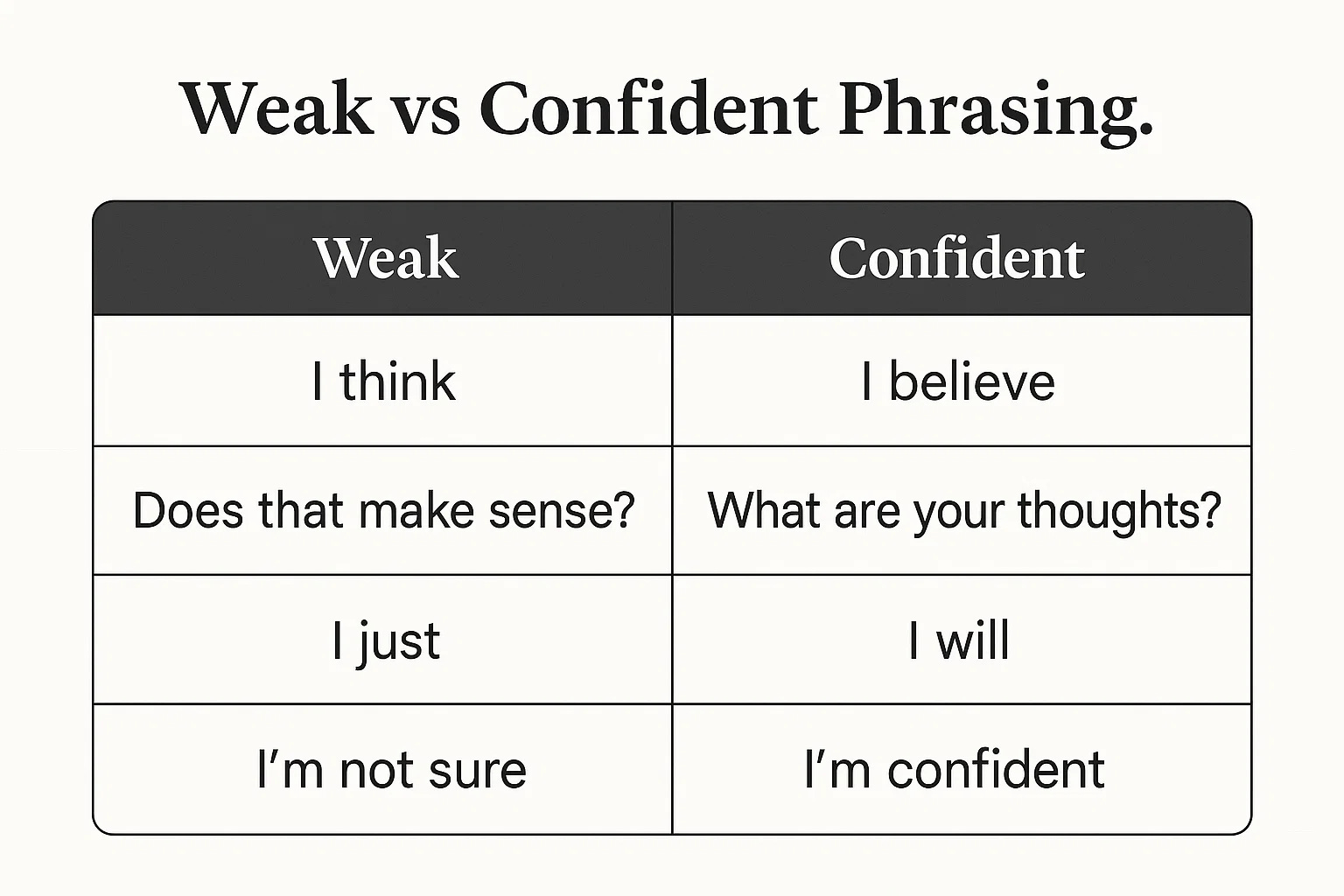
Tone is everything. Speak calmly, avoid filler, and keep your phrases short but warm, and practice until the words sound natural, not memorized. If you’re nervous, record yourself and listen for hesitations that weaken phrasing like “I just wanted to ask” or “I was hoping.” Replace them with steady openers:
“I’d like to discuss…”
“I’d love to explore…”
“I’m confident this adjustment reflects market value.”
Understanding Risk
Source: Harvard Business Review, “How to Negotiate Your Next Raise,”
Common Mistakes and Troubleshooting
1. Lack of Evidence
Saying “I deserve more” without proof kills momentum. Use numbers, results, and credible salary data.
2. Accepting the First Offer
Only 37% of professionals always negotiate. Those who do earn on average 7.4% more than peers.
3. Demanding Instead of Collaborating
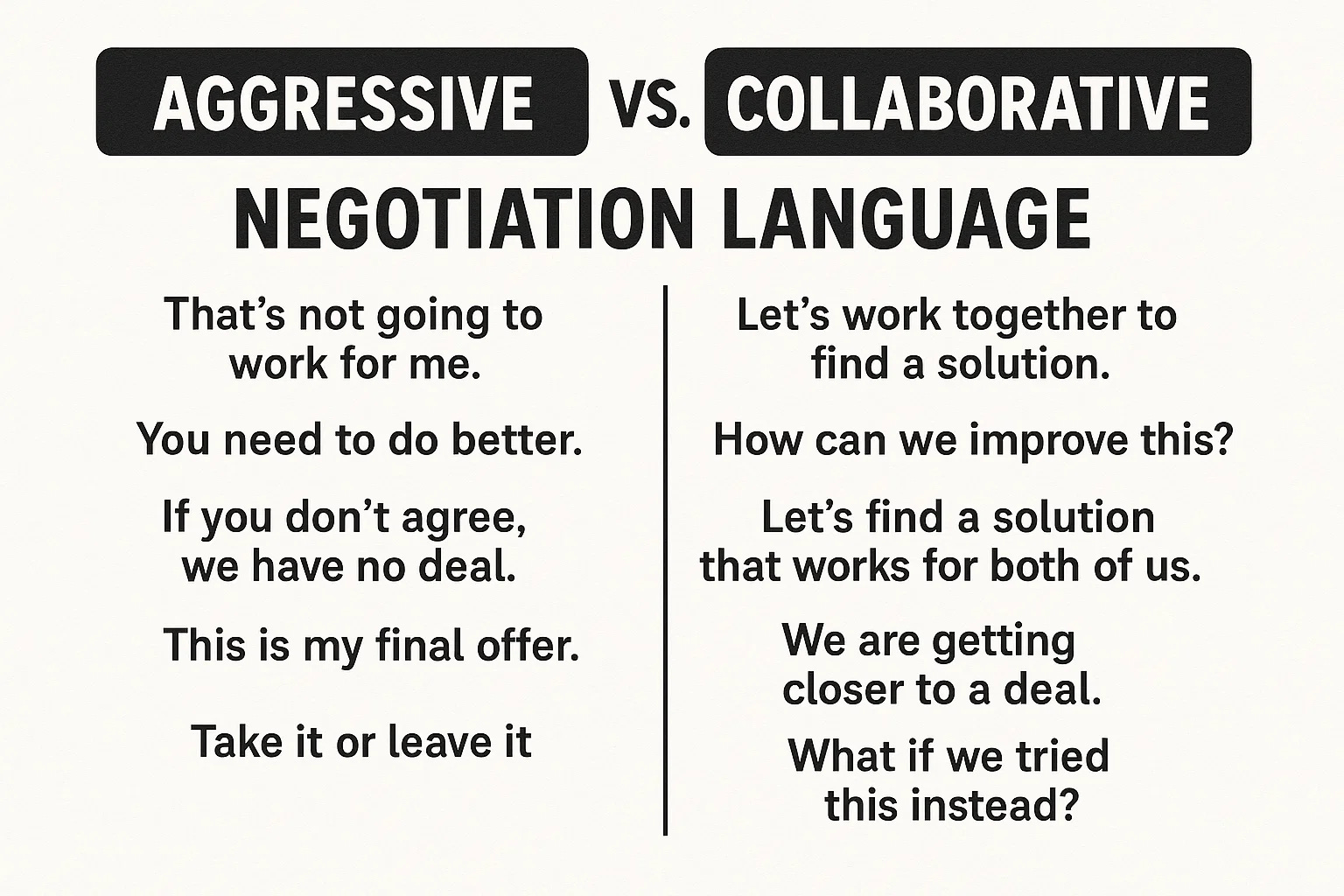
Replace “I need” with “Could we explore.” The tone signals partnership.
4. Ignoring Benefits and Perks
If salary maxes out, pivot to time, flexibility, or signing bonuses.
5. Failing to Document Agreements
Always request written confirmation of salary, bonuses, and timelines.
If You Hear “No”
Ask:
“What specific results would make this discussion possible next quarter?”
“Could we review in 3 months with defined targets?”
Record those answers, they become your next negotiation script.
Success Criteria: How You Know It Worked
✅ Written confirmation of updated terms
✅ Increase meets or exceeds your goal range
✅ Manager references your specific contributions
✅ Future review or promotion timeline documented
✅ Relationship remains collaborative
Cultural Context
Please keep in mind these scripts reflect U.S. professional and cultural norms. In other regions, salary discussion may be reserved for final stages or indirect phrasing. Adapt to local culture: emphasize enthusiasm and mutual benefit first, numbers second.
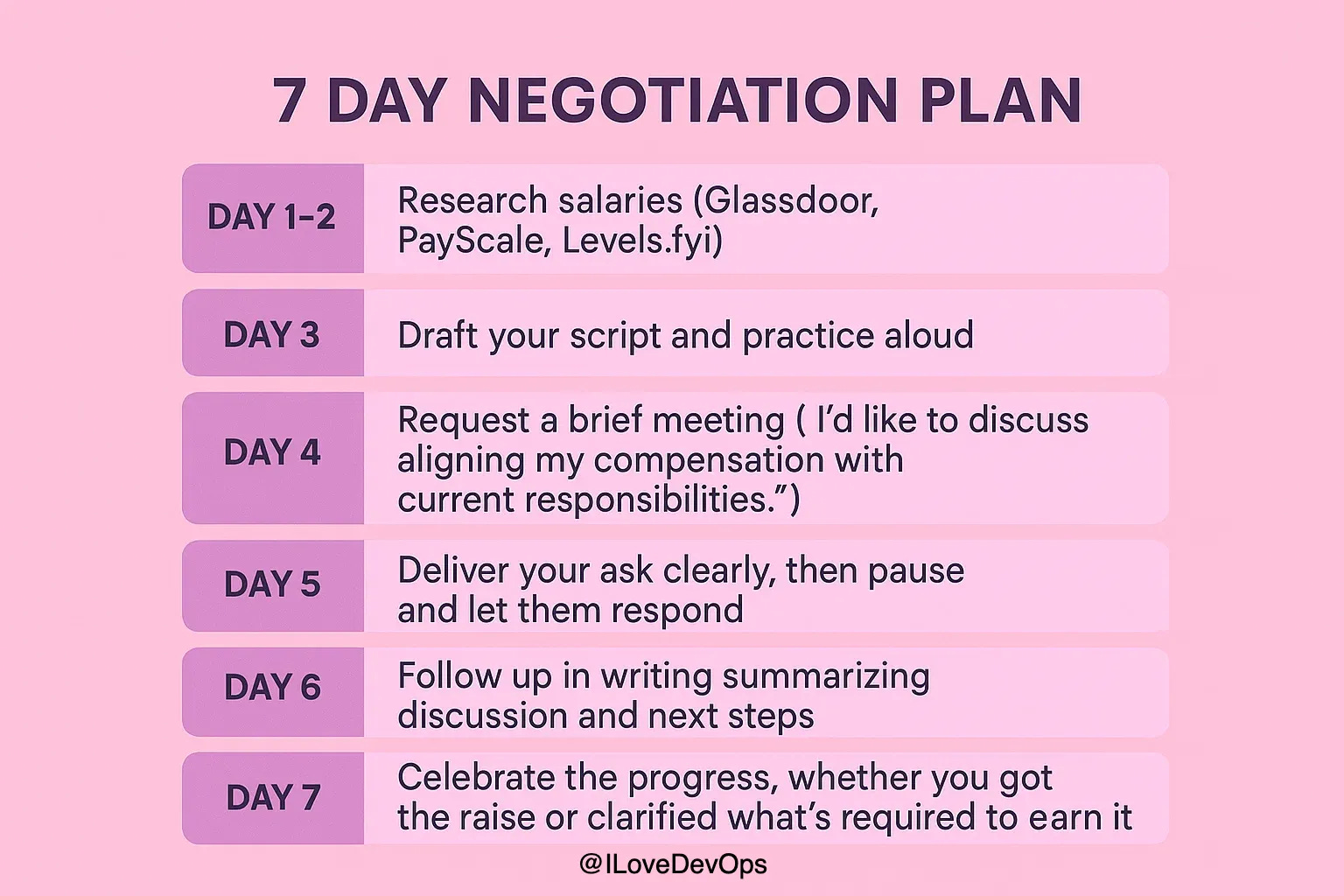
Applying This Guide in the Next 7 Days
Closing Thoughts
Salary negotiation is not a test of personality, it’s a professional alignment exercise. When you present clear data, articulate your impact, and stay collaborative, you control the outcome without confrontation. Every conversation you avoid costs you compound earnings over your career. Negotiation done well strengthens respect, clarity, and compensation. The only higher risk than asking is assuming your value speaks for itself.
Sources:
Salary.com 2025 Pay Practices Report
SHRM Global Pay Practices Report
Last Updated: November 2025