
The DevOps Skill That Changes Everything: Infrastructure as Code


There is one skill that separates beginners from engineers who get hired quickly.
One concept that instantly makes your portfolio stand out. One tool companies look for when choosing entry level cloud or DevOps candidates.
That skill is Infrastructure as Code, often called IaC.
If you understand IaC, you can automate cloud environments, deploy systems the same way every time, avoid misconfigurations, and prove to hiring managers that you think like a real engineer.
Most people skip this skill because it looks intimidating, but I am going to break it down clearly so you understand not only what it is, but how to practice it today.
What Infrastructure as Code Actually Means
Infrastructure as Code means you build your cloud environment using text files instead of clicking around the AWS console.
Instead of Click Ops for:
Launch Instance
Create Security Group
Create S3 bucket
IAM roles
VPC settings
…you write all those instructions in a set of files and run a single command to create everything.
This gives you:
repeatability
consistency
version control
documentation
automation
the ability to rebuild environments in minutes
This is how real companies operate at scale.
How to Visualize IaC (Explained Simply)

Imagine you are assembling IKEA furniture.
Option 1: You open the box, guess where each piece goes, and hope for the best.
Option 2: You follow the instruction booklet and recreate the same desk every time.
IaC is the instruction booklet. The cloud is the furniture.
Why Terraform Is the Tool to Learn First
There are multiple IaC tools, but Terraform is the industry standard because:
it works across AWS, Azure, and Google Cloud
companies use it for everything from startups to enterprise
it has clean syntax
it is beginner friendly
it integrates with CI and CD pipelines
it teaches you how infrastructure works under the hood
Terraform. If you learn only one IaC tool as a beginner, make it this one.
What Terraform Code Looks Like
This single block of code creates a server in AWS.
You did not click anything.
You did not open the console.
You described the server in code and Terraform built it for you.
The Terraform Workflow That Every Engineer Should Know
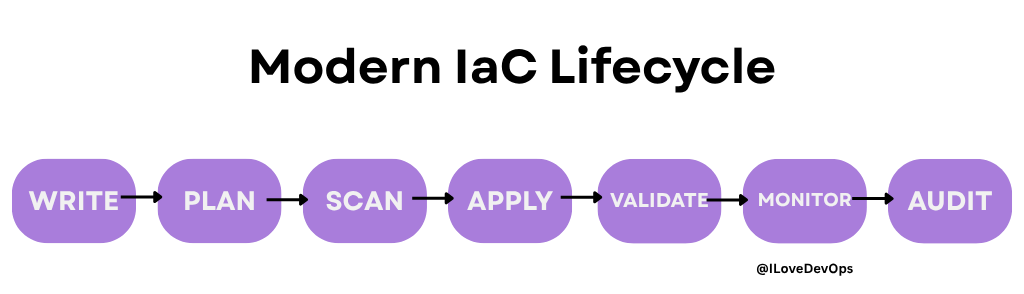
Here is the real workflow:
Write your infrastructure in
.tffilesRun
terraform initto download providersRun
terraform planto preview changesRun
terraform applyto build everythingUpdate code as needed
Run
terraform destroyto remove it all
This is the same workflow used on real engineering teams.
Success Criteria: How You Know You Understand IaC
You are ready for IaC based roles when you can:
write a Terraform file without copying and pasting
understand variables, outputs, and providers
deploy an EC2 instance through code
create an S3 bucket and IAM role through code
structure Terraform modules
connect IaC to a CI/CD pipeline
use GitHub to version control your Terraform state
If you understand the above, you are demonstrating real DevOps thinking.
The First Terraform Project Every Beginner Should Build
Start with something simple that teaches the essentials:
Project: Build a Small AWS Environment With Terraform
It should include:
1 VPC
2 subnets
1 EC2 instance
1 security group
1 S3 bucket
IAM role with basic permissions
This project checks all the boxes hiring managers look for.
Case Study: How IaC Got One Reader Hired Faster
A reader named Laura spent months learning cloud concepts but struggled to prove her skills. She could explain S3, EC2, and VPCs, but her portfolio did not show any real deployments.
When she learned Terraform, everything changed.
She created a Terraform module for a small EC2 setup, connected it to GitHub Actions for CI, and documented the entire build.
Her GitHub suddenly showed:
version control
automation
reproducible environments
clean code
diagrams
real infrastructure
She applied for junior cloud engineering roles, and in three weeks received two interviews. She landed an offer for $82,000 per year.
That is the power of IaC.
Common Beginner IaC Mistakes (And How to Avoid Them)
Here are the mistakes I see most often:
1. Overcomplicating modules too early
Start small. Build basic infrastructure first.
2. Ignoring terraform plan
This preview step helps you avoid expensive mistakes.
3. Not using version control
Your .tf files should always be in GitHub.
4. Building giant projects too soon
IaC is best learned through small, repeated practice.
5. Forgetting to destroy resources
You do not want surprise AWS bills. terraform destroy is your friend.
Tools You Can Use Today
All free. All beginner friendly.
Closing Thoughts ❤️

Infrastructure as Code is one of the most powerful skills you can learn in tech. It makes you faster, more reliable, more organized, and more hireable. When you understand IaC, you do not just understand cloud. You understand how real engineering teams work.
This week, choose one small IaC project and commit to finishing it.
It can be simple. It can be small.
Consistency matters more than complexity.
Real engineers build. If you build, you belong here.
With love and DevOps,
Maxine
PS: If you want a clear roadmap to start your DevOps career, my course walks you through everything I wish I knew when I transitioned into tech. ✨💻❤️
Last Updated: December 2025
Brilliant breakdown of why IaC actually matters! The IKEA furniture analogy captures somethign most tutorials miss - that its not just about automation but about having a repeatable process that works the same every single time. What catches peopel off guard though is that terraform plan becomes second nature only after you've been burned by an unexpected infrastructure change once or twice. The practice builds intuition faster than any documnetation ever could.