
Week in Tech: May 8-15, 2026
Red Hat Wants AI Agents Running Your Ansible Playbooks

This week had a lot of noise and a few things that actually matter.
Red Hat Summit dropped in Atlanta and the announcements were more practical than I expected. The Q1 cloud earnings numbers landed and the story they tell about where infrastructure spending is going is worth paying attention to. And a dataset on cloud traffic concentration quietly surfaced a multi-region resilience problem that nobody is talking about loudly enough.
Before we get started…
Hi I’m Maxine, a cloud infrastructure engineer who spends my days scaling databases, debugging production incidents, and writing about what actually works in production.
You can get a copy of my LLMs for Humans: From Prompts to Production (at 30% off right now) ←
Or for free when you become a paid subscriber.
It’s 20 chapters of practical applied AI with real production context, not theory. And it’ll help you get smarter about using AI tools in infrastructure workflows.
Checkout my work:
Plus, if you’re thinking about making a career move into cloud or DevOps and want a structured path to get there, get a copy of my The DevOps Career Switch Blueprint.
Let’s get into it
Red Hat Summit: Ansible Gets an AI Control Plane
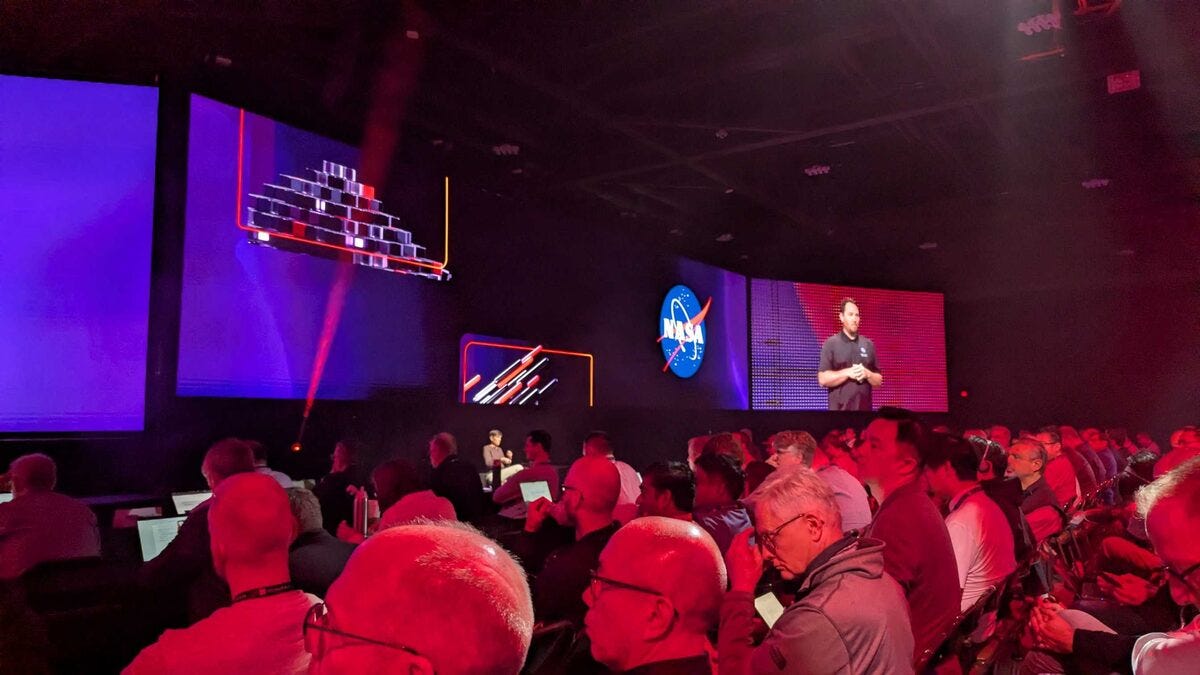
The headline out of Atlanta this week is Ansible Automation Platform 2.7, and the thing that actually matters in it is the new automation orchestrator and native MCP server integration.
Here is what Red Hat is actually saying: AI agents now have a governed execution layer to interact with your infrastructure. Instead of an LLM calling your APIs directly and doing whatever it decides is appropriate, Ansible sits in the middle as a policy-enforced execution layer. The agent recommends, ansible runs the playbook, and your existing governance controls still apply.
Red Hat framed this as the trusted execution layer for IT operations in an agentic era, providing what they call an industrial-grade connection between AI intelligence and IT action.
The MCP server piece is the part I find most interesting from a practical standpoint. Ansible Automation Platform 2.7 adds a technology preview of an orchestration engine for AI agents that invoke capabilities via an integrated Model Context Protocol server. That means your AI tooling can call Ansible capabilities directly, without custom integration code. The same protocol I’ve written about before for Claude integrations is now showing up as the connective tissue between AI agents and enterprise automation platforms.
Red Hat CEO Matt Hicks described AI as the third major platform inflection after Linux and Kubernetes. He reported that every organization at Red Hat, including teams that have never written production code, has contributed code to the company’s internal agent system, signaling a shift to an everyone-is-a-builder operating model.
That line deserves some skepticism.
Every company running AI internally says their agents are in production. The gap between “in production” and “running reliably at scale without humans catching mistakes” is still enormous. But the architectural direction here is right.
What this means for DevOps engineers: Your Ansible playbooks are not going to become obsolete because of AI. They are about to become the governing layer that makes AI actions safe to run in production. The engineers who understand both the playbook library and how to configure the governance policies around it are going to be the people orgs trust to run this.
The engineers who don’t understand either are going to find themselves in a difficult position when their org starts asking “why do we need people looped into this?”
Red Hat also deepened its collaboration with Nvidia, adding support for Nvidia’s Blackwell architecture and upcoming Vera Rubin platform, as well as participation in Nvidia’s OpenShell project for AI agent sandboxing and secure execution.
Sandboxed agent execution is the piece I want to see more of. An AI agent that can write files, call APIs, and modify infrastructure needs isolation boundaries. The container-native approach Red Hat is taking with Podman Desktop is the right instinct.
Q1 Cloud Earnings: The Numbers That Actually Matter
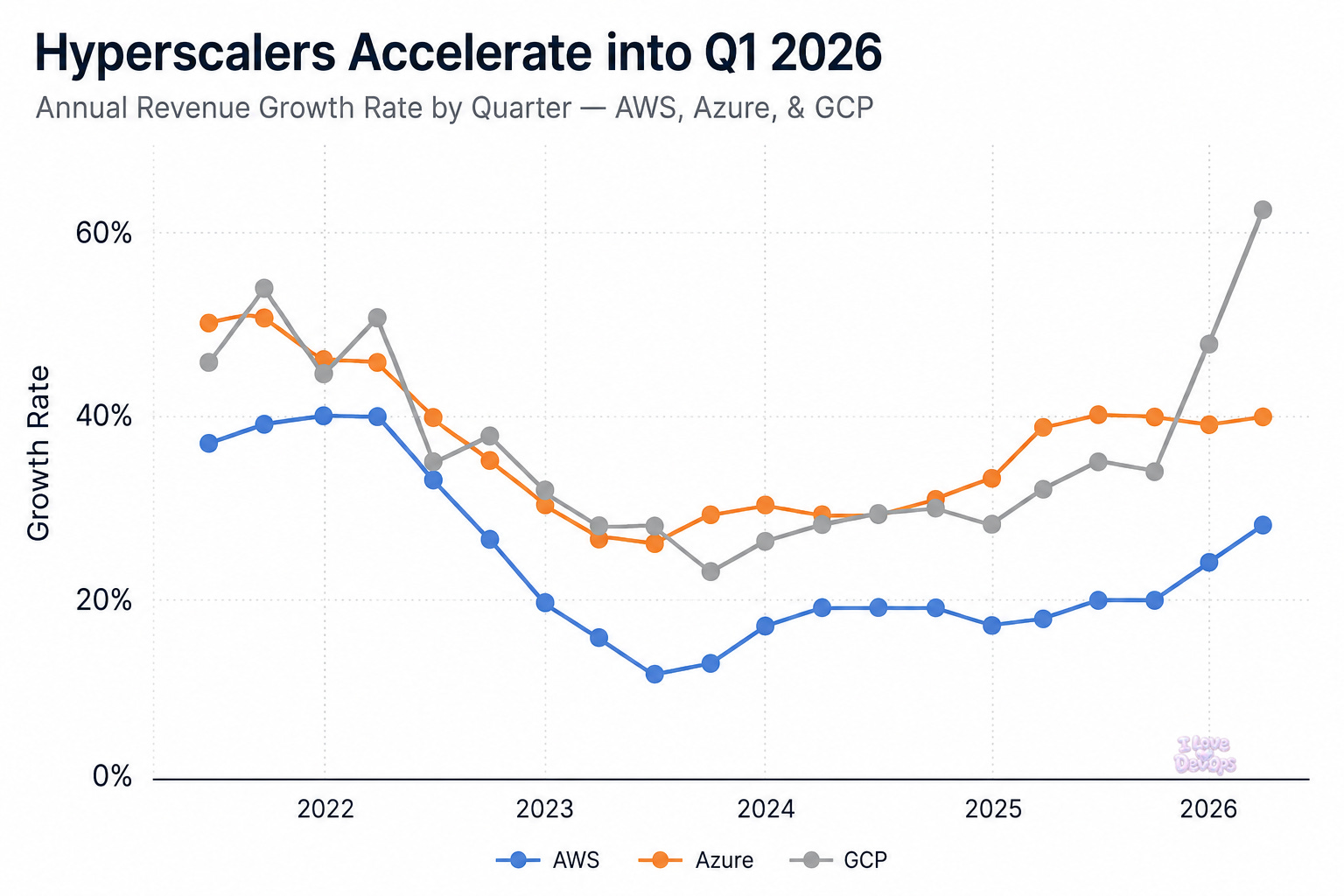
All three hyperscalers reported this week and the headlines were mostly about growth rates.
The numbers underneath are more interesting.
AWS revenue for Q1 2026 came in at $37.59 billion, up 28.4 percent year over year. Azure posted 40% growth, with Microsoft’s cloud revenue reaching $34.7 billion. Google Cloud delivered what analysts are calling its fastest growth rate on record.
Three clouds, all growing fast. That part is not surprising.
What is worth paying attention to: Amazon is on track to spend $200 billion on capex this year, with the majority going to AWS and generative AI. AWS and Anthropic have reportedly inked deals to get additional Trainium2 and Trainium3 capacity into the field, with analysts describing the commitments as spanning years, not quarters.
That is a long-term compute bet.
Not a roadmap.
A structural commitment.
Andy Jassy said something interesting on the earnings call about potentially selling Trainium racks directly to customers rather than just renting compute. Based on reporting from the call, he indicated that selling racks is very much a possibility, with the caveat that they have to balance existing demand against how much capacity to allocate for direct sales versus cloud rental. The substance of that direction is confirmed. The exact framing is my read of the reporting.
If AWS becomes a hardware OEM alongside being a cloud provider, the infrastructure procurement conversation at enterprise scale changes significantly. Your cloud bill and your capital equipment budget start converging.
For working engineers: the GPU capacity constraints are real and not going away. If you are running AI workloads in production, plan for longer provisioning lead times, plan for pricing pressure as providers try to recoup these investments, and take the multi-cloud and hybrid conversations seriously. Not as redundancy. As capacity access strategy.
The us-east-1 Problem Nobody Is Talking About Loudly Enough
A traffic analysis dataset covering Q1 2026 cloud infrastructure surfaced something uncomfortable this week.
The me-central-1 outage and a late-March drone disruption were described as the clearest stress tests for multi-region adoption seen in the dataset, with data suggesting that if traffic concentration continues to tick upward despite the outage backdrop, the multi-region disaster-recovery best-practices framework is failing in production at a measurable scale.
Translation: organizations are saying they have multi-region strategies. The traffic patterns suggest many of them do not actually have multi-region strategies. They have a primary region and a documented failover that has never been tested under real conditions.
I’ve seen this in real environments, the Terraform is written for two regions, and the runbooks say “failover to us-west-2.” But then something happens in us-east-1 and the failover procedure turns out to have undocumented dependencies that nobody touched since it was written.
The drill that was never run is the plan that will not work.
From what I can tell, no single Azure region comes close to the concentration that us-east-1 carries for AWS workloads. Azure distributes more evenly across its 75-region footprint by design.
That AWS concentration is the one that should be on your radar if you run AWS workloads. us-east-1 is where most AWS services launch first, where the most capacity lives, and where a meaningful outage has the widest blast radius. I’ve seen this pattern in real environments and the traffic data this week suggests it’s not getting better. If your architecture assumes us-east-1 availability without a tested failover path, you are carrying more risk than your runbooks suggest.
Quick Hits: Everything Else Worth Knowing
Azure’s new regions are actually routing real traffic.
Poland central, central India, New Zealand North, and Belgium Central all broke into Azure’s top 14 regions in April, absorbing real workload traffic rather than just holding compliance certifications. The sovereignty-driven region buildout is moving from press releases to actual production use. If you have clients in regulated European or APAC industries, the conversations about data residency are going to get more specific.
The cloud control plane war is getting clearer.
The battle is shifting from models to platforms to control planes, with each major vendor arriving at the same conclusion from a different starting point: the company that owns the control plane owns the customer relationship for the next decade. AWS owns developer gravity and infrastructure depth. Azure owns enterprise distribution through Microsoft 365. Google is betting it can collapse all of those layers into one integrated system. Watch where your organization’s control plane loyalty actually sits. It will determine your optionality for the next five years.
Wiz security scanning is now inside vibe-coded apps.
Wiz can now help secure vibe-coded applications, running security scanning directly inside the Lovable platform so vulnerabilities, secrets, and misconfigurations surface in Lovable’s built-in security view. The security tooling is catching up to where the code is actually being written. This matters because AI-generated code has a specific class of security problems around secrets handling and permission scoping that traditional SAST tools were not tuned for.
Red Hat’s skills repository is a sleeper announcement.
Beyond the Ansible news, Red Hat announced a new dedicated AI skills repository, giving AI agents access to over two decades of Red Hat support information, knowledge base, and operational capabilities. Institutional memory as a first-class AI primitive. That is actually an interesting idea and I expect other tooling vendors to follow the same pattern.
What to Watch Next Week
The Ansible Automation Platform 2.7 general availability timeline is worth tracking. The technology preview is interesting. The production release is what tells you whether this is a real architectural shift or a conference announcement.
Also watch for more earnings-driven infrastructure spending announcements. Amazon reports on AI workload growth specifics later in the quarter and the Trainium rack sale question will come up again.
If you are managing AWS workloads, this is a good week to pull your actual traffic distribution across regions and ask honestly whether your failover documentation reflects reality.
What is your organization actually doing about us-east-1 concentration risk?
I’d be curious whether the multi-region runbooks at your company have been tested recently. Find me in the comments.
With Love and DevOps,
Maxine
If you made it this far and you’re managing AWS cloud infrastructure with Terraform, you might want to keep this one close too.
is where I start people who are new to AWS or who understand it conceptually but haven’t had to debug it in a real environment yet. It covers the mental model behind declarative infrastructure so that articles like this one make sense end to end, not just the code snippets.

And if you’re working with AI in your stack or trying to understand where LLMs actually fit in a production system without the hype, LLMs for Humans: From Prompts to Production is the guide I wish existed when I started. Written by an engineer for engineers, covering RAG, function calling, and the operational reality of running AI in real systems.
Let’s stay connected
I post about cloud infrastructure, DevOps, and AI in production a few times a week on LinkedIn. The real stuff: what I’m debugging, what I’m deploying, and the occasional thing that broke in a way nobody documented anywhere.
Come say hi. I actually respond.
Last Updated: May 2026
Sources and Further Reading
Red Hat Establishes Ansible Automation Platform as the Trusted Execution Layer for IT Operations
Red Hat Previews AI Agent Integration with Ansible Automation Platform
Red Hat Brings Developers, Product, and Operations to the Center of Agentic AI
The Q1 Cloud Face-off Is Over: There Was 1 Clear Winner
AWS Will Be An OEM, Just Like Google And Maybe Microsoft
Cloud Provider Traffic Share in Q1 2026
Google Cloud Next 2026 Preview: The Real Story Isn’t AI, It’s the Control Plane